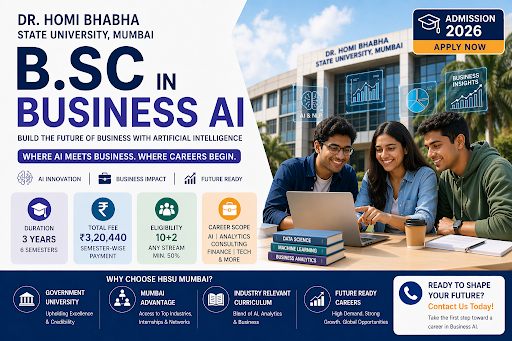
Higher education in India is undergoing a significant structural shift — one that is moving access to quality university study from a privilege of geography and circumstance to a realistic option for students across economic and social backgrounds. Dr Homi Bhabha State University Mumbai occupies a distinctive position in this shift. Established to honour the legacy of the pioneering nuclear scientist Dr Homi Jehangir Bhabha, the university carries a mandate that is both historically significant and practically urgent: to provide accessible, rigorous, and career-relevant higher education to students who might otherwise be excluded from it.
The university operates under the regulatory framework of the Government of Maharashtra, serving students across Mumbai and beyond through a combination of affiliated colleges and its own academic infrastructure. Its emphasis on applied learning, professional relevance, and academic credibility makes it a meaningful choice for students who are evaluating where to build their undergraduate foundation — particularly in emerging fields such as artificial intelligence, where the quality of the programme directly determines the quality of the career that follows.
Table of Contents
9 sections — ~12 min read- 01What a B.Sc. in Business AI Actually Is — and Why It Is Different
- 02Why HBSU Mumbai Is a Credible Choice for Business AI
- 03Course Structure and Curriculum Orientation
- 04Who Can Apply: Entry Requirements
- 05How to Apply: Admission Process for 2026
- 06Understanding the Full Investment: Fee Structure
- 07Career Pathways and Sectors for Graduates
- 08Salary Expectations and Future Scope
- 09Frequently Asked Questions
📌 Key Takeaway: HBSU is not simply a legacy institution — it is one that has positioned itself at the intersection of academic accessibility and professional relevance. For students seeking a credible undergraduate qualification in a forward-looking field, the university's mandate and infrastructure make it a considered choice.
What a B.Sc. in Business AI Actually Is — and Why It Is Different from a Standard Technology Degree
The Business AI Course India landscape is still developing — and among the programmes that have emerged to meet the growing demand for graduates who can operate at the intersection of artificial intelligence and commercial decision-making, the B.Sc. in Business AI at HBSU represents a genuinely distinct offering. It is not a computer science degree with a business elective, nor a business administration degree with an AI module. It is a purpose-built programme that develops the analytical, technical, and commercial capabilities that organisations deploying AI in real business environments actually need.
The AI in business degree concept reflects a structural gap that has become increasingly visible in India's talent market: organisations understand that AI can transform their operations, but they struggle to find professionals who can bridge the technical capability of AI systems with the business context in which those systems will be applied. The B.Sc. in Business AI is designed to produce exactly those professionals — graduates who understand both the mechanics of AI and the organisational, commercial, and ethical dimensions of deploying it effectively.
📌 Key Takeaway: A B.Sc. in Business AI is a cross-disciplinary qualification by design — not by compromise. The combination of technical AI literacy and business application capability is precisely what makes graduates of this programme valuable in ways that pure technology or pure business graduates are not.
Why HBSU Mumbai Is a Credible Choice for Students Serious About Business AI
The question of which institution to pursue a B.Sc. in Business AI at is not simply a matter of convenience or familiarity — it is a decision that will shape the quality of preparation, the credibility of the credential, and the range of career options available at graduation. HBSU Mumbai brings a combination of institutional standing, regulatory oversight, and programme design that makes it a considered option for students who take this decision seriously.
Mumbai's position as India's commercial capital is directly relevant to a Business AI programme. Students studying in this environment have access to the industries — financial services, media, technology, retail, logistics, and healthcare — that are most actively deploying AI in real operational contexts. The proximity to practitioners, potential employers, and internship opportunities is a structural advantage that students at HBSU can leverage throughout their programme, not just at graduation. For a programme where the connection between academic study and applied practice is central to the value of the degree, this institutional positioning matters.
📌 Key Takeaway: Institutional location is not incidental for a Business AI programme — Mumbai's commercial ecosystem provides a live learning environment that students can engage with throughout the degree. This proximity to real AI deployment contexts is a meaningful differentiator.
📋 Ready to explore the B.Sc. in Business AI at Dr Homi Bhabha State University? Contact Us to get the latest information on admission dates, eligibility, and how to begin your application for 2026.
Get in Touch📌 Key Takeaway: The admission process is clear and manageable — but attention to document accuracy and timely response to university communications at each stage is essential. Students who prepare their documents in advance and monitor their application actively will navigate the process most efficiently.
Course Structure and Curriculum Orientation: What Three Years of Business AI Study Build
The B.Sc. AI course after 12th at HBSU is a three-year undergraduate programme structured across six semesters. The curriculum is designed to develop technical proficiency progressively — beginning with foundational concepts in mathematics, programming, and business principles, moving through applied AI methods and data analysis, and culminating in advanced topics in business AI applications, strategic deployment, and emerging technologies. The programme's structure reflects its core design principle: technical depth and business application are developed concurrently, not sequentially.
Rather than treating AI as a subject studied in isolation, the curriculum consistently contextualises technical learning within commercial and organisational scenarios. Students develop the ability to evaluate where AI adds genuine value in a business context, how to design AI-supported decision-making processes, how to communicate AI insights to non-technical stakeholders, and how to assess the ethical and regulatory implications of AI deployment. These capabilities — developed alongside technical proficiency in AI methods and tools — are what distinguish a Business AI graduate from a general computer science graduate or a general business graduate.
📌 Key Takeaway: The B.Sc. Business AI programme is structured so that technical and commercial learning reinforce each other throughout the three years. Students who engage with both dimensions develop a professional profile that is genuinely more versatile than either a pure technology or a pure business degree produces.
Who Can Apply: Entry Requirements for the B.Sc. Business AI Programme
The eligibility criteria for the B.Sc. in Business AI at HBSU are designed to be inclusive without compromising the preparedness of those admitted. Applicants must have successfully completed the 10+2 examination — or an equivalent qualification — from any recognised board, achieving a minimum of 50% marks in aggregate. Notably, the programme welcomes students from all three academic streams: whether a student has studied Science, Commerce, or Arts at the senior secondary level, they are equally eligible to apply.
This stream-agnostic eligibility is a deliberate design choice. Business AI, as a discipline, benefits enormously from the perspectives of professionals with varied academic backgrounds. A student from a Commerce background brings financial and commercial reasoning; one from Arts brings cultural and communication sensitivity; one from Science brings mathematical and analytical depth. The programme is built to develop AI and business capability from any of these starting points — meaning that the most important qualifier for admission is not prior subject knowledge, but the intellectual curiosity and commitment to engage seriously with a cross-disciplinary programme.
📌 Key Takeaway: The 50% aggregate and stream-agnostic eligibility reflects a considered approach to access — the programme is designed to develop capability from diverse starting points, not to restrict entry to those with prior technical backgrounds. What matters at the point of admission is the commitment to engage seriously with what the programme demands.
How to Apply: The Admission Process for B.Sc. Business AI at HBSU 2026
The admission process for the B.Sc. in Business AI at Dr Homi Bhabha State University is designed to be straightforward and transparent. The following table maps each step clearly, including what students should keep in mind at each stage to ensure the process moves smoothly.
| # | Step | What It Involves |
|---|---|---|
| 01 | Apply Online | Access the official HBSU application portal and complete the online application form. Ensure all personal and academic details are entered accurately. Verify that the portal is open for the B.Sc. Business AI programme and the 2026 intake before beginning. |
| 02 | Submit Documents | Upload the required supporting documents as specified by the university — typically including 10th and 12th mark sheets, a recent passport-size photograph, identity proof, and any applicable category certificates. Ensure all documents are legible and correctly formatted before submission. |
| 03 | Application Review | The university reviews submitted applications against the eligibility criteria. Students should monitor the email address provided in their application for any communication requesting additional information or clarification during this stage. |
| 04 | Fee Payment | Upon receiving an admission offer or provisional selection notification, complete the fee payment through the designated payment gateway. Retain the transaction confirmation as proof of payment. |
| 05 | Start Learning | Following successful enrolment, students receive access to their programme materials and orientation details. Review the academic calendar, programme structure, and any pre-commencement guidance provided by the university before the programme begins. |
Understanding the Full Investment: HBSU B.Sc. Business AI Fee Structure
For students and families planning for the financial commitment of a three-year undergraduate programme, clarity about the complete fee structure is essential. The HBSU courses and fees for the B.Sc. in Business AI are structured transparently, allowing students to plan their financial commitments across the six semesters of the programme. The table below presents the complete breakdown.
The total programme fee of ₹3,20,440 covers the complete three-year B.Sc. Business AI. Students are advised to verify the per-semester breakdown of course and examination fee components directly with HBSU at the time of application, as the allocation across semesters may be confirmed upon enrolment. The per-semester structure provides a predictable and manageable payment schedule, allowing students and families to plan financial commitments in regular instalments across the three years of study.
📌 Key Takeaway: A total investment of ₹3,20,440 for a three-year programme in one of India's most in-demand professional fields represents a considered financial commitment. Students evaluating this investment should weigh it against the salary and career trajectory data for Business AI graduates — the return profile is consistently favourable for those who engage seriously with the programme.
Where a B.Sc. in Business AI From HBSU Takes Graduates: Career Pathways and Sectors
The career scope for graduates of a B.Sc. in Business AI is genuinely broad — and the breadth reflects the cross-sectoral nature of AI adoption itself. Every industry that uses data to make decisions — which is, increasingly, every industry — requires professionals who can bridge the technical capability of AI systems and the business context in which those systems are applied. This is precisely the profile that a Business AI graduate develops.
| Career Role | Sector / Function | What It Involves |
|---|---|---|
| Business Analyst (AI-enabled) | Cross-sector | Using AI tools and data analytics to generate business insights and support strategic decision-making. |
| AI Product Manager | Technology / Product | Defining the vision and roadmap for AI-powered products — bridging technical development and commercial strategy. |
| Data Analyst | Cross-sector | Collecting, processing, and interpreting data to support operational and strategic decisions across functions. |
| AI Implementation Consultant | Consulting / Advisory | Advising organisations on how to deploy AI solutions effectively within their operational and strategic context. |
| Marketing Analytics Specialist | Marketing / Digital | Using AI and data tools to analyse consumer behaviour, optimise campaigns, and measure commercial performance. |
| Financial AI Analyst | Banking / Finance / FinTech | Applying AI methods to financial modelling, risk assessment, fraud detection, and investment analysis. |
| Supply Chain Analyst | Logistics / Operations | Using AI to optimise inventory, demand forecasting, and logistics management within complex supply chains. |
| HR Analytics Specialist | Human Resources | Applying data and AI tools to workforce planning, talent acquisition, engagement analysis, and attrition prediction. |
| Entrepreneur / AI Startup Founder | Any sector | Building AI-powered products or services — a growing pathway for graduates with both technical and commercial capability. |
| Postgraduate Study (MBA / MCA / M.Sc. AI) | Academic / Professional | Deepening expertise or changing direction — the B.Sc. Business AI is a strong foundation for postgraduate progression. |
📌 Key Takeaway: Business AI graduates are not limited to a single industry or function — their cross-disciplinary capability makes them relevant wherever organisations are deploying AI in commercial contexts. The variety of career pathways available reflects the versatility of the degree itself.
Salary Expectations and Future Scope for Business AI Graduates
Salary data for Business AI graduates in India reflects both the genuine demand for the skill set and the wide variation in compensation across sectors, roles, and levels of applied capability. The following overview provides a reference for students evaluating the career financial returns of the programme, with the important caveat that these are indicative ranges, not guaranteed outcomes, and the graduate's own specialisation, employer, and demonstrated capability will significantly influence where they land within any range.
| Role / Level | Indicative Salary (INR p.a.) | Key Factors Driving Compensation |
|---|---|---|
| Entry-level Analyst / Associate | ₹4 – 7 LPA | Organisation size, sector, and demonstrated applied capability at graduation. |
| Data / Business Analyst (2–3 years) | ₹7 – 12 LPA | Specialisation, tool proficiency, and ability to generate measurable business impact. |
| AI Product / Implementation Role | ₹10 – 18 LPA | Commercial acumen combined with technical credibility — a premium for this combination. |
| Marketing / Financial AI Specialist | ₹8 – 16 LPA | Sector premium applies — financial services and technology command the strongest compensation. |
| Senior Analyst / Consultant (5+ years) | ₹15 – 28 LPA | Track record of applied contribution and demonstrated leadership of AI initiatives. |
| AI Strategy / Leadership Role | ₹25 – 50+ LPA | Senior roles requiring both strategic AI understanding and organisational influence. |
📌 Key Takeaway: Business AI compensation is strong at every level and accelerates rapidly with specialisation and demonstrated impact. The graduates who reach the upper end of any range are consistently those who combine technical credibility with commercial acumen — precisely the profile the programme is designed to develop.
The Capabilities a Business AI Graduate Develops: Technical Depth and Professional Breadth
The skills developed during a B.Sc. in Business AI span two dimensions that are equally important to professional effectiveness — and both are developed throughout the programme rather than in separate tracks. Technical capability without commercial understanding produces graduates who can build AI systems but not deploy them effectively. Commercial understanding without technical capability produces graduates who can discuss AI but not contribute to it meaningfully. The programme develops both.
🧠 Technical & Analytical Skills
- Machine learning concepts and applications
- Data analysis and statistical modelling
- Python and AI tool proficiency
- Database querying and management
- Predictive analytics and forecasting
- AI system evaluation and performance measurement
- Data visualisation and dashboard design
- Natural language processing fundamentals
💼 Business & Professional Skills
- AI strategy and deployment planning
- Business case development for AI initiatives
- Stakeholder communication and presentation
- Ethical AI assessment and governance
- Project management and delivery
- Commercial problem framing and solution design
- Cross-functional collaboration
- Critical thinking and evidence-based decision making
📌 Key Takeaway: The skill set developed in a Business AI programme is genuinely dual-layered — and that duality is the source of the graduate's professional value. Students who invest equally in developing both dimensions will be more effective, more versatile, and more competitive than those who develop only one.
The Decade Ahead: Why Business AI, Data Science, and Quantum Computing Define the Next Professional Frontier
For students choosing a three-year undergraduate programme today, the relevant question is not simply what is in demand now — it is what will be in demand when they graduate, and for the decade of professional life that follows. On that basis, the Business AI Course India landscape is positioned at the beginning of a long and sustained growth trajectory, not at a cyclical peak that may correct.
AI adoption across India's economy is still in its early stages relative to where it will be by 2030. The financial services sector is moving from AI experimentation to AI-as-infrastructure. Healthcare is beginning to deploy AI in diagnostics, drug discovery, and patient management at scale. Retail, logistics, and manufacturing are embedding AI into core operational processes. Government and public administration are investing in AI-enabled citizen services. Each of these transitions generates demand for professionals who understand both the technology and the business context — and that demand will compound, not plateau.
Beyond current AI applications, data science continues to deepen as a discipline, with increasing integration of real-time analytics, edge computing, and automated decision systems. Quantum computing — while still in its early deployment phase — is moving from research laboratories toward commercial applications in finance, pharmaceuticals, and cryptography. Students who graduate with a strong Business AI foundation are well-positioned to engage with these developments as they mature, because the fundamental capability they have developed — applying advanced analytical methods to commercial problems — transfers across these emerging fields.
📌 Key Takeaway: The future scope of Business AI is not speculative — it is grounded in observable structural trends across India's economy. Students who invest in this capability now are positioning themselves for a professional landscape that will reward their preparation consistently and increasingly over the decade ahead.
Accessing HBSU's Student Portal: Login, Results, and Academic Resources
For enrolled students at Dr Homi Bhabha State University, the student portal is the primary interface for academic administration — providing access to course materials, examination schedules, results, and university communications. Understanding how to navigate this system effectively is a practical skill that directly supports academic performance throughout the programme.
The HBSU student login portal is accessible through the university's official website. Students receive their login credentials — typically a university-assigned ID and password — upon enrolment confirmation. Through the portal, students can access their academic record, including semester-wise results, download hall tickets for examinations, submit assignments where digital submission is required, and access official university notifications about academic calendars, fee payment deadlines, and programme updates. Students who encounter login or access issues should contact the university's IT support or administrative office directly — the student portal team is the appropriate first point of contact for technical difficulties, not third-party aggregator sites that may not carry current information.
📌 Key Takeaway: The student portal is a practical tool that supports academic organisation throughout the programme. Students who engage with it regularly — checking results, downloading resources, and staying current with university communications — manage their academic progression more effectively than those who treat it as an occasional resource.
A Balanced Assessment: Strengths and Considerations for Prospective B.Sc. Business AI Students
A well-informed decision about any programme requires honest engagement with what it does well and what it requires from the student. The following assessment is offered as a practical reference — not to create an unrealistically positive impression, but to give prospective students the kind of balanced view that genuinely useful guidance requires.
✔ Strengths
- Purpose-built cross-disciplinary programme combining AI and business — rare at the undergraduate level in India
- Open to students from Science, Commerce, and Arts streams — broad eligibility
- Mumbai location provides direct access to commercial AI deployment contexts and industry networks
- Strong future-proof career scope across financial services, technology, consulting, and emerging AI sectors
- Develops both technical and commercial capability simultaneously — producing a genuinely versatile professional profile
- Supported by HBSU's institutional standing and regulatory oversight under the Government of Maharashtra
- Pathway to strong postgraduate options, including MBA, MCA, and M.Sc. in AI or Data Science
⚠ Considerations
- As a relatively newer programme category, employer awareness may vary — graduates should be prepared to articulate the programme's value clearly
- The cross-disciplinary nature requires genuine engagement with both technical and commercial dimensions — students who resist one or the other will limit the value they extract
- Total fee of ₹3,20,440 is a significant investment — students should plan financial commitments carefully across the three years
- Applied AI roles at competitive employers often expect supplementary portfolio work — academic qualifications alone may not be sufficient without demonstrated projects
- Students from non-Science backgrounds may need to invest additional effort in building mathematical and programming foundations in the early semesters
📌 Key Takeaway: The B.Sc. Business AI at HBSU is a strong programme for students who are genuinely drawn to the intersection of AI and commercial decision-making. The considerations are real but manageable — most can be addressed through deliberate preparation, intellectual curiosity, and consistent engagement with both dimensions of the curriculum throughout the three years.
The Case for Choosing Business AI: What This Degree Builds That Others Do Not
The B.Sc. in Business AI at Dr Homi Bhabha State University occupies a distinctive space in India's undergraduate programme landscape — one that reflects where the economy is heading rather than where it has been. The graduates who will be most valued in the decade ahead are not those with the deepest technical AI expertise alone, nor those with the broadest business knowledge alone — they are those who can do both and connect the two in ways that create genuine organisational value.
For students who approach this programme with intellectual seriousness — who engage equally with the technical and commercial dimensions of the curriculum, who seek out applied experience alongside their academic study, and who develop the communication capability to translate AI insight into business language — the degree provides one of the most relevant and forward-looking career foundations available at the undergraduate level in India today.
The HBSU Mumbai campus, Mumbai's commercial ecosystem, and the programme's cross-disciplinary design together create a learning environment that is genuinely positioned for the professional reality graduates will enter. For students who are clear that they want to build their career at the intersection of artificial intelligence and business impact, this is where that preparation begins.
📌 Final Insight: The professionals who will define AI's role in India's economy are not being produced by technology departments or business schools alone — they are being produced by programmes that develop both, simultaneously and in genuine integration. The B.Sc. in Business AI at HBSU is built for exactly that purpose.